
- 1. The Unique Demands Placed on High Speed Motor Shafts
- 2. The Role of Material Science in High-Speed Shaft Design
- 3. Precision Manufacturing: The Bridge Between Design and Performance
- 4. Dynamic Behavior and the Challenge of Resonance
- 5. Integration with Bearing Systems and Lubrication
- 6. Testing and Validation for High-Speed Applications
- 7. Frequently Asked Questions
1. The Unique Demands Placed on High Speed Motor Shafts
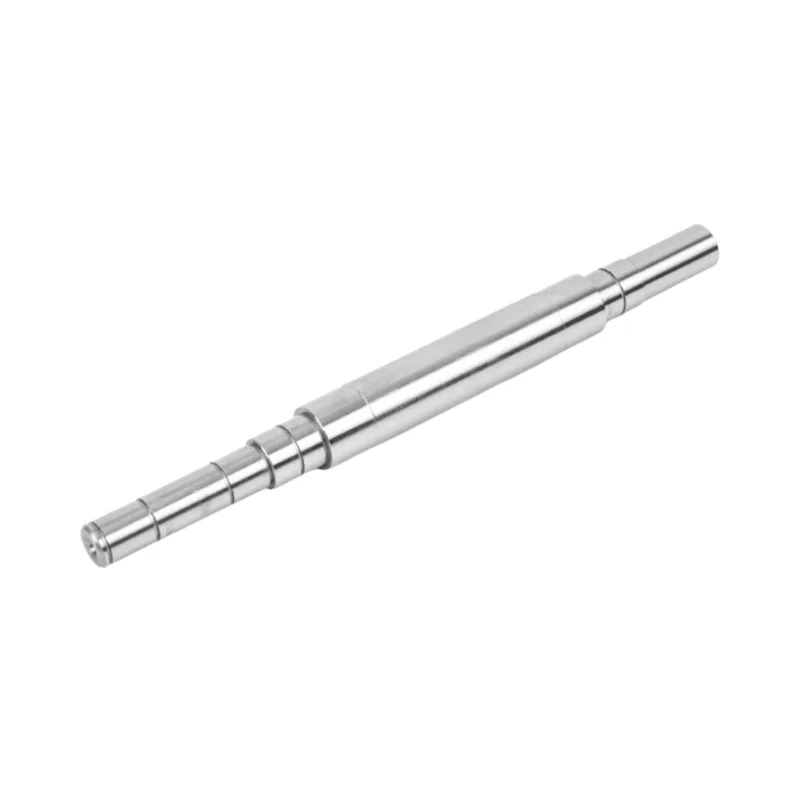
As electric motors are pushed to higher power densities and smaller form factors, the rotational speeds of their shafts have increased dramatically. A High Speed Motor Shaft typically operates at velocities exceeding 20,000 rpm, with some advanced designs reaching 150,000 rpm or more. At these speeds, the shaft is subjected to centrifugal accelerations that can exceed 10,000 times the acceleration of gravity, imposing enormous stresses on the material and demanding extraordinary precision in every aspect of its design and manufacture.
⚡ Centrifugal Forces
Radial growth and stress increase with the square of speed. Even minor imbalances become destructive at high rpm.
🔥 Thermal Gradients
Windage and bearing friction generate heat, causing differential expansion that affects clearances and alignment.
🌀 Dynamic Instability
Operation near critical speeds can excite resonant vibrations, leading to rapid failure if not addressed.
⚙️ System Integration
The shaft must interact seamlessly with rotor, bearings, seals, and load, requiring holistic design.
Key performance indicators for a high-quality high-speed motor shaft include dimensional stability, rotordynamic stability, fatigue endurance, surface integrity, and material homogeneity. These attributes are not achieved by chance; they are the result of careful material selection, rigorous manufacturing processes, and comprehensive quality assurance protocols.
- Dimensional stability – maintaining geometric accuracy under thermal and mechanical loads.
- Rotordynamic stability – avoiding critical speeds and exhibiting adequate damping.
- Fatigue endurance – withstanding millions of stress cycles without crack initiation.
- Surface integrity – smooth finishes to minimize friction and stress risers.
- Material homogeneity – free from inclusions, porosity, or segregation.
2. The Role of Material Science in High-Speed Shaft Design
The material chosen for a High Speed Motor Shaft directly influences its strength, stiffness, fatigue resistance, and thermal behavior. No single material satisfies all requirements perfectly, so the selection process involves trade-offs based on the specific application's speed, load, temperature, and environmental conditions.
| Material | Density (g/cm³) | Young's Modulus (GPa) | Tensile Strength (MPa) | Fatigue Limit (MPa) | Cost Level |
|---|---|---|---|---|---|
| Alloy Steel 4140 | 7.85 | 210 | 1,100 | 450 | Low |
| Alloy Steel 4340 | 7.85 | 205 | 1,200 | 480 | Low |
| Stainless 17-4 PH | 7.80 | 195 | 1,300 | 500 | Medium |
| Titanium Ti-6Al-4V | 4.43 | 114 | 950 | 510 | High |
| Maraging Steel (18Ni) | 8.00 | 186 | 1,900 | 650 | Very High |
Thermal properties are equally important. The coefficient of thermal expansion (CTE) determines how much the shaft will grow radially and axially as temperature rises during operation. A mismatched CTE between the shaft and the rotor lamination stack or bearing inner race can create interference problems or loss of press-fit retention. Materials with lower CTE, such as certain nickel alloys or composites, are preferred in applications with wide temperature swings.
3. Precision Manufacturing: The Bridge Between Design and Performance
Even the most carefully designed high-speed motor shaft will fail to meet performance expectations if manufacturing introduces geometric errors, surface defects, or residual stresses. Precision manufacturing is therefore essential to realize the theoretical benefits of the material and design.
🔧 Forging & Heat Treatment
Aligns grain structure and achieves target hardness, reducing residual stresses for stability.
⚙️ Precision Grinding
Delivers tolerances within microns and surface roughness below 0.2 μm Ra, critical for bearing journals.
✨ Superfinishing
Reduces roughness to sub-0.1 μm, enhancing fatigue strength and reducing friction.
🔩 Thread Rolling
Preferred over cutting for splines/keyways because it induces compressive residual stress, boosting fatigue life.
Dynamic balancing, as described in the next section, is performed as a finishing operation to correct any residual unbalance. The balancing process itself is a precision operation, often requiring several iterations to achieve the required balance grade.
- CMM inspection – verifies all critical dimensions with high accuracy.
- Non-destructive testing – ultrasonic and magnetic particle methods detect hidden flaws.
- Statistical process control – ensures consistent quality across production lots.
4. Dynamic Behavior and the Challenge of Resonance
One of the most formidable challenges in high-speed motor shaft engineering is managing the dynamic response of the shaft-rotor system. The High Speed Motor Shaft must be designed such that its operating speed range is clear of any critical speeds (natural frequencies) to avoid resonance, which can lead to excessive vibration, bearing damage, and catastrophic failure.
Two primary design strategies:
- Stiff shaft – first critical speed is above maximum operating speed; simpler balancing, but requires larger diameter or shorter span.
- Flexible shaft – operates above first critical speed; allows lighter design but demands multi-plane balancing and often active damping.
In addition to bending modes, torsional critical speeds must also be considered. Torsional resonances occur when the shaft's torsional natural frequency coincides with torsional excitation from the motor's torque pulses or from the driven load. Designers typically use torsional vibration analysis to ensure adequate separation between torsional natural frequencies and excitation orders.
Experimental verification is performed during prototype testing by running a speed sweep while monitoring vibration. Strain gauges or accelerometers confirm predicted mode shapes and frequencies, guiding any necessary design revisions.
5. Integration with Bearing Systems and Lubrication
The high-speed motor shaft does not operate in isolation; its performance is intimately linked to the bearing system that supports it. Bearings must accommodate the shaft's rotational speed, radial and axial loads, and thermal expansion while maintaining low friction and adequate damping.
🔄 Rolling Element Bearings
Speed-limited due to centrifugal stresses on balls/rollers. Suitable for moderate high-speed applications.
💧 Fluid Film Bearings
Hydrodynamic or hydrostatic; excellent damping and load capacity, but require clean lubricant and can suffer oil whirl instability.
🧲 Magnetic Bearings
Active or passive; contactless, ultra-high speed capability, adjustable stiffness, but complex control and power requirements.
🛢️ Lubrication Strategies
Oil viscosity, cooling, and filtration are critical for thermal management and film formation in fluid bearings.
Proper alignment between the motor shaft and the driven equipment is another crucial factor. Misalignment can impose additional bending moments on the shaft and lead to localized heating, premature bearing failure, and increased vibration. Precision alignment tools and techniques, such as laser alignment, are used during installation and should be verified periodically during maintenance.
6. Testing and Validation for High-Speed Applications
Before a high-speed motor shaft is released for production, it must undergo rigorous testing to validate its design, manufacturing quality, and reliability under simulated operating conditions. The testing program typically includes several stages, from material characterization to full-speed endurance tests.
- Material testing – coupons verify tensile, yield, hardness, and fatigue properties against design allowables.
- NDT inspection – ultrasonic, eddy current, and dye penetrant detect internal and surface defects.
- Dynamic balancing – achieves specified balance grade (typically G1.0 or better).
- Full-speed spin test – run to max speed while monitoring vibration, temperature, and bearing condition.
- Endurance test – hundreds of hours at full load to validate fatigue life and wear characteristics.
7. Frequently Asked Questions
Typically, a motor shaft is considered high-speed when it exceeds 20,000 rpm. However, the classification depends on the specific application and the shaft's diameter. In general, any shaft where dynamic balancing, critical speed analysis, and thermal management become dominant design considerations is classified as high-speed.
The critical speed is proportional to the square root of the shaft's stiffness-to-mass ratio. Materials with higher specific stiffness (E/ρ) yield higher critical speeds for a given geometry. Titanium and composites have higher specific stiffness than steel, allowing them to achieve higher critical speeds with the same diameter, or same speed with a smaller diameter.
For most high-speed applications (20,000–50,000 rpm), a balance quality grade of G1.0 or better per ISO 1940-1 is standard. For ultra-high-speed applications exceeding 100,000 rpm, G0.4 or higher precision is often required to maintain acceptable vibration levels.
Minor surface damage such as scoring or mild wear can sometimes be repaired by grinding and polishing, provided the shaft's dimensions remain within tolerance. However, cracks, excessive wear, or severe damage typically necessitate replacement, as welding or other repair methods can introduce residual stresses and affect the shaft's dynamic behavior. A thorough inspection and risk assessment should be conducted before any repair attempt.
The most frequent failure modes are fatigue cracks initiated at stress concentrations (keyways, fillets, or surface imperfections), vibration-induced damage due to unbalance or resonance, and overheating caused by inadequate lubrication or cooling. Corrosion and wear in bearing journal areas are also common, especially in harsh environments. Most failures can be prevented by rigorous design, precision manufacturing, and regular maintenance monitoring.
Need a high-performance motor shaft tailored to your specific application?
Guanshuo offers custom engineering and precision manufacturing of high-speed motor shafts for automotive, aerospace, and industrial sectors.
Contact usOur team provides expert support in material selection, design optimization, and production scalability.